Shop Rolex Watches Online in Oman
There are watch brands, and then there is Rolex. The distinction matters, because Rolex occupies a category of its own — not just in terms of price or prestige, but in terms of what the watch actually means to the person wearing it. When someone puts on a Rolex for the first time, something shifts. It is not a feeling you can manufacture with marketing. It comes from 120 years of doing one thing with absolute consistency: making watches that are better than they need to be.
Hans Wilsdorf started the company in London in 1905, but it was never really a London story. By 1919 it had moved to Geneva, and by 1926 Rolex had already changed the watch industry forever with the Oyster — the world's first truly waterproof wristwatch. A year later, British swimmer Mercedes Gleitze wore an Oyster across the English Channel. It kept perfect time. Rolex ran a full-page advertisement about it in the Daily Mail the next morning. That instinct — to prove the watch in the real world rather than simply talk about it — has defined the brand ever since.
What followed over the next century is a list of firsts that no other watch company can match. The first self-winding mechanism. The first date display on a wristwatch. The first watch certified as a chronometer by an external authority. The first dive watch rated to 100 metres. Then 300 metres. Then 3,900 metres. Rolex did not just make watches — it kept expanding what a watch was capable of, and then put those watches on the wrists of the people actually doing the things those watches were built for. On the summits of mountains. In the depths of the ocean. On the wrists of the astronauts, racing drivers, and explorers who defined the second half of the twentieth century.
None of that heritage would matter if the watches themselves were not extraordinary. But they are. Every component in a Rolex — from the alloy in the case to the lubricants in the movement — is developed and manufactured in-house. The steel Rolex uses, called Oystersteel, is a proprietary formula not available to any other watchmaker. The gold, called Everose gold, is a pink gold alloy Rolex developed specifically because traditional pink gold fades over time. Theirs does not. The sapphire crystal covering the dial is scratch-resistant to a degree that most other watch crystals are not. Each finished movement is tested for a minimum of fifteen days before it leaves the factory, and it must gain or lose no more than two seconds per day to receive Rolex's own Superlative Chronometer certification — a standard significantly tighter than the industry benchmark.
On Ubuy Oman, you can explore a wide selection of Rolex watches imported from verified international sellers, covering everything from the entry-level Oyster Perpetual to the precious metal Day-Date. All orders are delivered across the Sultanate — Muscat, Salalah, Sohar, Nizwa, Sur, and beyond — with full tracking and reliable international shipping. Whether you are buying your first Rolex or adding another reference to a collection you have been building for years, this is a genuine place to find it.
Rolex Collections Worth Knowing
The Rolex catalogue is not large by design — the brand deliberately keeps its lineup focused. But within that focused range, every model has earned its place, and most of them have been in continuous production for decades. These are the references that matter most.
Rolex Submariner
The Submariner is the watch that most people picture when they hear the word Rolex, and for good reason. It has been in continuous production since 1953, it has appeared on the wrists of more famous people than any other watch in history, and it manages the rare feat of looking equally right in a boardroom, at a dinner table, or thirty metres underwater.
The original Submariner was built as a professional diving instrument, rated to 100 metres — remarkable for 1953. Today's version is rated to 300 metres, which is far beyond what any recreational diver will ever encounter. It has a unidirectional rotating bezel calibrated in minutes, so a diver can track elapsed time with a gloved hand. The movement inside is Rolex's Calibre 3235, built entirely in-house, carrying a seventy-hour power reserve and that distinctive near-silent sweep of the seconds hand.
The Submariner comes in stainless steel, and in two-tone combinations with yellow, white, or Everose gold. The Submariner Date has a date window at three o'clock; the no-date version keeps the dial clean. Both are correct. Which one you choose says something about what kind of watch person you are.
Rolex Datejust
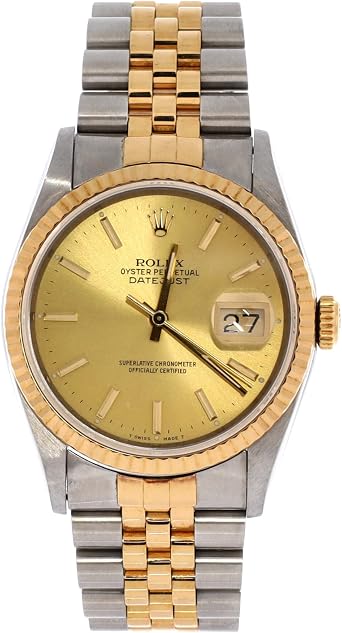
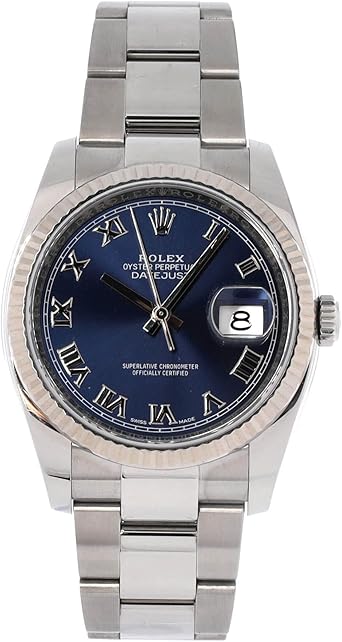
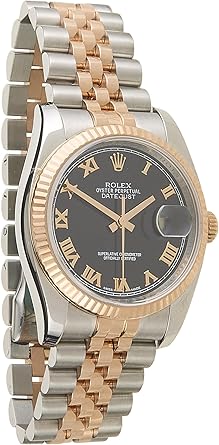
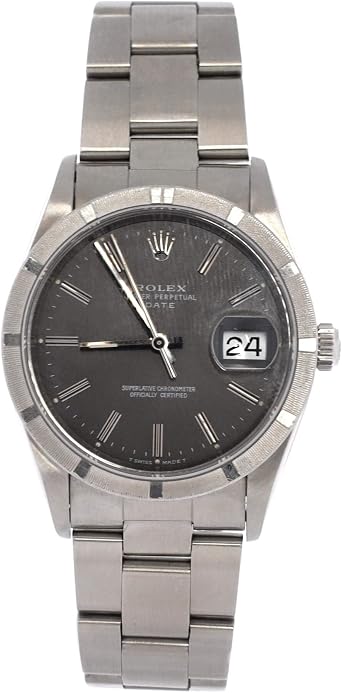
The Datejust arrived in 1945 — the same year the Second World War ended — as the first self-winding wristwatch in the world to display the date automatically through a window in the dial. It changed watchmaking. It also set the aesthetic template that Rolex has refined over the following eight decades without ever needing to fundamentally rethink.
The modern Datejust comes in 36mm and 41mm, in a range of case materials, bezels, dials, and bracelet combinations that runs to the hundreds. You can have it in polished steel with a fluted bezel and an Oyster bracelet. You can have it in white gold with a diamond-set bezel and a midnight blue dial. You can have it in two-tone Rolesor — half steel, half gold — in ways that look far less dated than comparable watches from any other brand. The Datejust is the most versatile watch Rolex makes, which is likely why it has consistently been the most popular.
Rolex Day-Date
The Day-Date is what Rolex makes when it is not making concessions to anyone. Introduced in 1956, it was the first watch in history to display both the day of the week and the date — the day spelled out in full in a window at twelve o'clock, the date in the usual window at three. It was also, from the very beginning, available exclusively in precious metals: 18-karat gold or platinum. There has never been a steel Day-Date. There never will be.
The Day-Date has been worn by every American president since Dwight Eisenhower, along with heads of state, royalty, and leaders from virtually every country on earth. It became known as the President watch in part because of this, and the President bracelet — with its rounded three-piece links — was designed specifically for it. In Oman, the Day-Date holds particular significance: Rolex produced specially commissioned pieces featuring the Omani Khanjar dagger on the dial, gifted by the Sultanate, that are now among the most sought-after collectibles in the watch world.
If you are buying a Day-Date, you are not buying a watch because you need to tell the time. You are buying it because you understand what it represents, and because few things you can put on your wrist will be received with more immediate recognition.
Rolex GMT-Master II
The GMT-Master was designed in the 1950s in collaboration with Pan American World Airways, for pilots who needed to track two time zones simultaneously on long-haul intercontinental routes. The original dial had a two-colour bezel — red and blue, now referred to as the Pepsi — so the pilot could distinguish between daytime and nighttime hours on the 24-hour scale. Fifty years later, the logic behind that design is just as sound, and the watch is just as relevant.
The current GMT-Master II is available with several bezel combinations — the classic Pepsi in red and blue, the Batman in black and blue, and the Sprite in black and green among the most recognizable. The additional 24-hour hand tracks a second time zone independently of the main hour hand, which can be moved in one-hour increments without stopping the movement.
For anyone who travels frequently, or who has colleagues and family in different time zones, it is the most practical luxury watch available. The fact that it also looks remarkable is almost secondary.
Rolex Daytona
The Cosmograph Daytona is the watch Rolex did not intend to become what it became. It was introduced in 1963 as a tool watch for professional racing drivers — the tachymeter bezel lets you calculate average speed over a measured distance, and the three sub-dials function as a stopwatch. For the first two decades, it sold slowly and without particular fanfare.
Then Paul Newman wore one. Then watch collectors noticed how few had been made. Then the waiting lists started. Today, the Daytona is one of the most coveted watches in the world, with examples in steel routinely selling at auction for multiples of their retail price. The current version is powered by Rolex's Calibre 4130, available in steel, gold, and two-tone configurations, with a range of dial colours that changes each year.
If you want a Daytona, you may need to wait for one. That has been the reality for decades, and it shows no sign of changing.
Rolex Oyster Perpetual
The Oyster Perpetual is where the Rolex story begins, and it is the most honest expression of what the brand is actually about. No date window. No additional complications. Just the Oyster case, the Perpetual movement, and a dial in one of several vivid colours — coral red, turquoise blue, yellow, green — that are genuinely striking against the simplicity of everything else.
The Oyster Perpetual is the least expensive Rolex by a meaningful margin, which sometimes leads people to overlook it. That is a mistake. The movement inside is the same generation of Rolex calibre as the more expensive models. The case and bracelet are finished to the same standard. The Superlative Chronometer certification applies equally. What you are getting is a complete Rolex watch — not a lesser version of one.
Rolex Explorer & Explorer II
The Explorer was worn on the first successful ascent of Everest in 1953 — on the wrist of Tenzing Norgay — and it has remained in continuous production ever since. The dial is always black, and the three, six, and nine positions are marked in Arabic numerals specifically because they are the easiest to read in difficult conditions. It is a watch that has been refined rather than redesigned, and it shows.
The Explorer II adds a 24-hour hand and a fixed 24-hour bezel, designed originally for cave explorers who spend extended periods underground without access to daylight. Both models carry a quiet confidence that more complicated watches sometimes fail to project.